Ijen Volcano, located on the island of Java in Indonesia, represents one of the most amazing and unique natural objects in the world.
This volcanic complex is known for its unusual natural phenomena, such as the blue fire of sulfur and the acidic crater lake.
Geographically, Ijen Volcano is located in the eastern part of the island of Java and attracts the attention of researchers and tourists from all over the world. Here one can observe an amazing combination of natural beauty and extreme living conditions.
We will tell you about the unique features of Ijen Volcano, the history of its eruptions, geographical location, as well as the impact of its activity on the life of the local population and the environment.
Geographical Location
Ijen Volcano is located in the eastern part of the island of Java in Indonesia, on the administrative territory of the province of East Java.
The coordinates of Ijen Volcano are approximately 8°03′30″ south latitude and 114°14′30″ east longitude.
This volcano is part of a larger volcanic group called the "Ijen Complex", which includes several other volcanoes, the highest of which is Mount Raung, reaching 2,799 meters above sea level.
Nearby settlements include:
- Banyuwangi City - located approximately 20 kilometers south of the volcano
- Bondowoso - located slightly closer to the east.
- Paltuding - a small settlement from where tourist routes to the summit of Ijen Volcano usually begin.
Characteristics
The height of Ijen Volcano is approximately 2,386 meters above sea level. It has a caldera about 20 kilometers wide, formed as a result of a major eruption in the distant past.
Kawah Ijen Lake
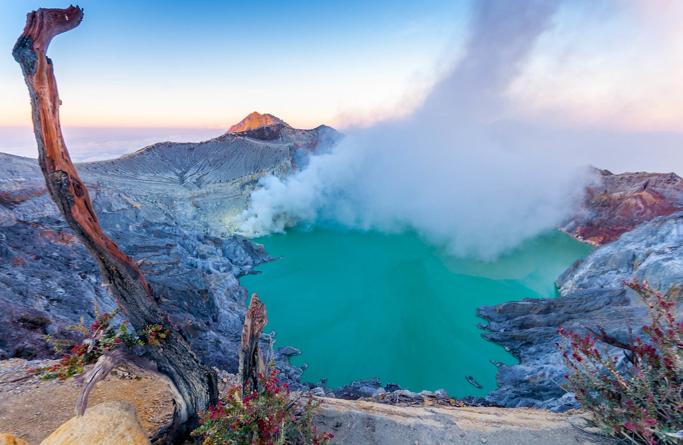
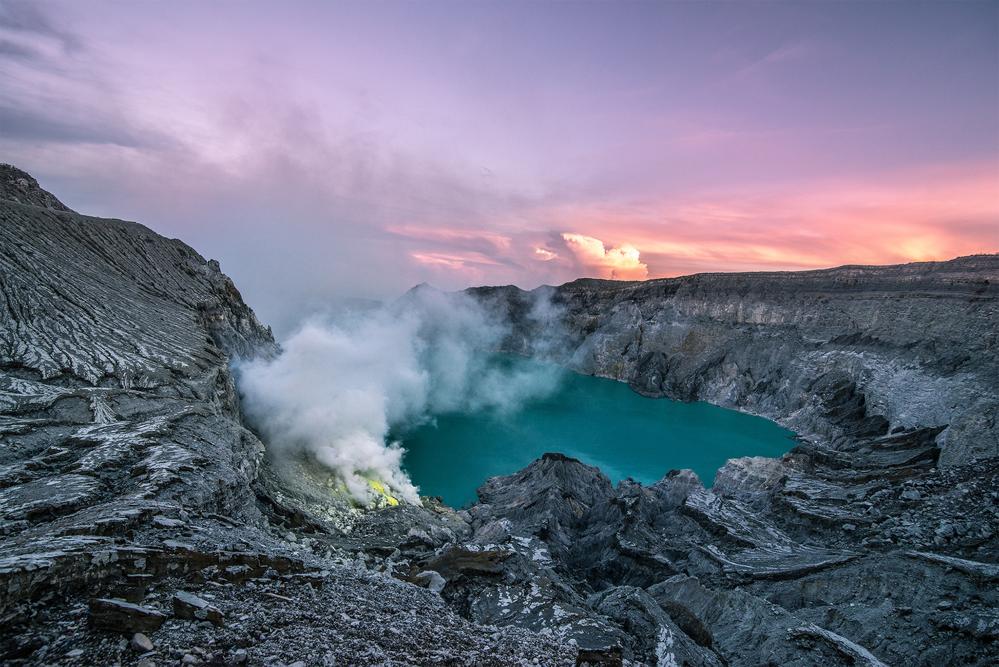
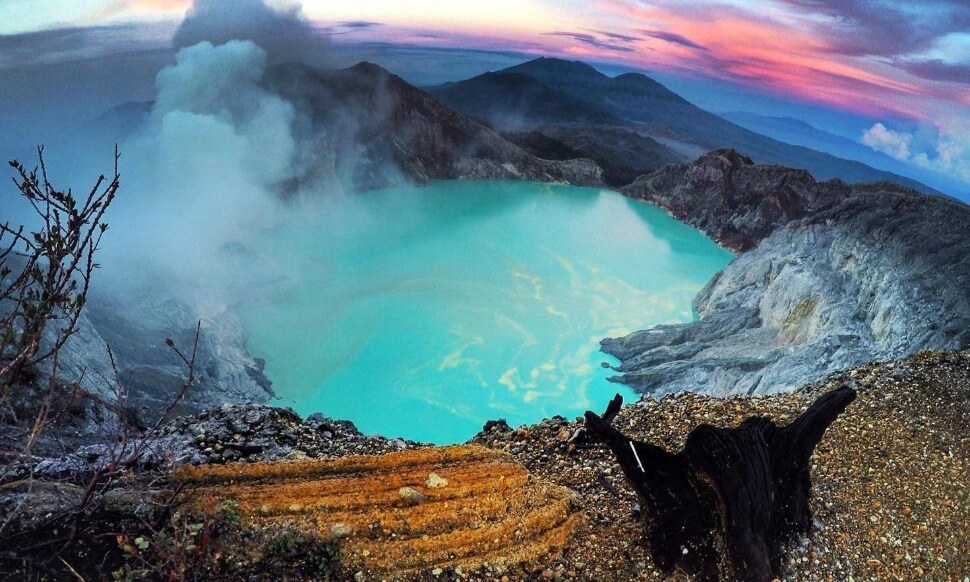
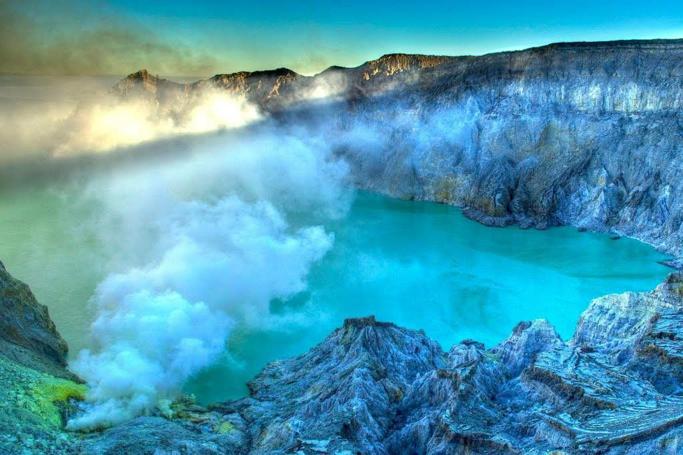
In the southern part of the caldera lies the crater lake Kawah Ijen, known for its saturated turquoise color and high acidity level (pH<1). The lake has a depth of up to 200 meters and is the largest acidic lake in the world.
Besides its acidity, it is also known for containing about 36 million cubic meters of a mixture of sulfuric and hydrochloric acid. The lake is fed by the condensate of hot volcanic gases.
The lake temperature varies from 27 to 45 degrees Celsius, and its color changes from green to turquoise depending on the lighting level and the observer's viewing angle.
Eruption History
The eruption history of Ijen Volcano counts several centuries of the last recorded eruptions.
The strongest eruptions were recorded in 1796, 1817, 1917, 1936, 1952, 1993, 1994, 1999, 2000-2002.
Eruptions are often accompanied by emissions of sulfur gases, ash, and pyroclastic flows, which pose a threat to the local population.
Unique Natural Phenomena
-
Blue Fire. This is one of the most mesmerizing phenomena associated with Ijen Volcano. It occurs during nighttime eruptions of sulfur gas. When gases containing a lot of sulfur reach the surface through cracks in the crater, they ignite, forming bright blue flames. The temperature of the reactions can reach 600 degrees Celsius. This phenomenon is best visible at night or at dawn, as daylight makes it less noticeable.
-
Acidic Crater Lake Kawah Ijen is also a unique natural object. Due to the high acid content, the lake's contents are extremely dangerous to life. However, despite the extreme conditions, some species of bacteria have been discovered here, indicating the possibility of life even in such an aggressive environment.
-
Sulfur Deposit on Ijen Volcano is actively mined by locals. Sulfur is extracted manually without the use of special protective equipment. Miners collect solidified pure sulfur, which they then carry out of the crater in baskets. This work is extremely dangerous due to the toxicity of sulfur gases and difficult natural conditions.
Ecological and Economic Aspects
The process of sulfur mining at Ijen Volcano represents one of the most heavy types of labor.
Miners work in extremely dangerous conditions without the use of additional protective equipment, leading to various respiratory diseases. However, despite all the dangers, sulfur mining is an important source of income for the local population. Sulfur is sold for use in the chemical industry, for example, in the production of fertilizers or in the sugar refining process.
Volcanic activity also affects the region's economy. Tourism plays an increasingly important role in the economy of nearby settlements. Annually, Ijen Volcano attracts thousands of tourists wishing to see the blue fire and the acidic lake. However, the growth of tourism can have a negative impact on the environment, increasing the load on the volcanic complex's ecosystem.
An ecological problem is also the emissions of sulfur gases, which can pose a danger to both local residents and the flora and fauna located around.
Several times in history, cases have been recorded where toxic emissions led to the death of people and animals.
Tourism and Accessible Infrastructure
The most popular tourist routes to Ijen Volcano are hiking ascents from the village of Paltuding to the crater rim.
The ascent is usually performed at night to reach the crater in time to catch the blue sulfur fire. The path to the crater takes about 2-3 hours, and the descent takes about 1-2. Along the tourist route, one can meet miners engaged in sulfur extraction.
Tourists are recommended to have good physical fitness, as the ascent is quite difficult and requires walking on steep slopes.
It is extremely important to have a respirator or gas mask to protect against toxic sulfur gases near the crater.
At the volcano's summit, the temperature is usually quite low, so warm clothing is also a mandatory element of your equipment.
What is nearby?
Besides the volcano itself and Lake Kawah Ijen, tourists often visit nearby natural attractions such as the Banyu Wana Amertha Waterfall (Bangsinga) and coffee plantations.
Conclusion
Ijen Volcano is not only one of the most unusual and mesmerizing volcanic objects in the world but also a place where natural wonders and the harsh working conditions of local residents combine.
The blue fire and the acidic crater lake make Ijen a unique natural phenomenon attracting tourists and researchers from all over the world.
If you ever happen to be on the island of Java, do not miss the opportunity to enjoy the beauty and mysteries of Ijen Volcano, but always remember the importance of preserving its unique landscape and environment!